Roof Insurance Claims Help for Missouri City Homeowners
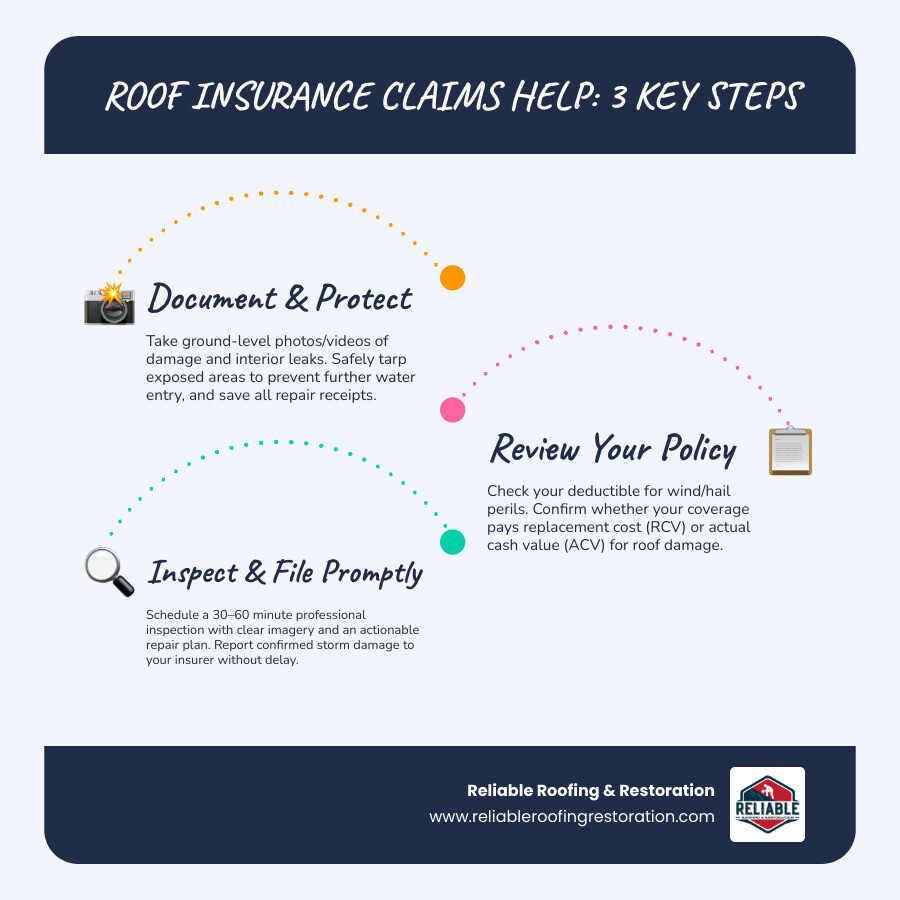
For roof insurance claims help, take these steps first:
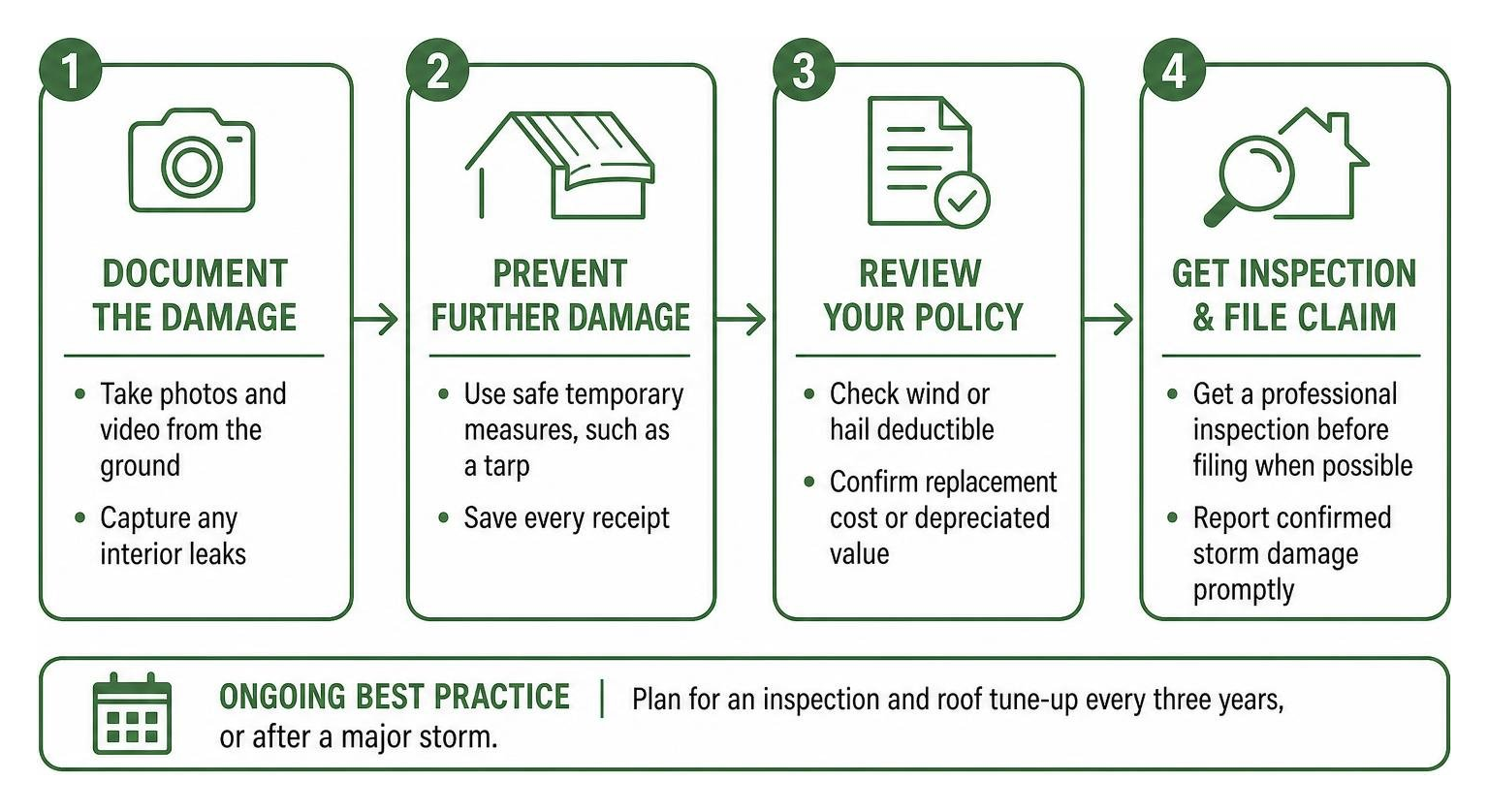
- Document the damage with photos and video from the ground, plus any interior leaks.
- Prevent further damage with safe temporary measures, such as a tarp, and save every receipt.
- Review your policy for the wind or hail deductible and whether your roof is paid at replacement cost or depreciated value.
- Get a professional inspection before filing when possible, then report confirmed storm damage promptly.
Texas wind and hail can cause damage that is easy to miss, including lifted shingles, damaged vents, and water entry points. A thorough roof inspection typically takes 30-60 minutes. Choose a contractor based on Google Reviews and a strong local reputation, and ask for clear imagery and an actionable repair plan rather than vague findings. Plan for an inspection and roof tune-up every three years, or after a major storm.
I am David Shepherd, and I help oversee storm-damage inspections, estimates, contractor coordination, and client communication for Reliable Roofing & Restoration in Texas. My experience with roof insurance claims help focuses on making the damage, repair scope, and next steps easier for homeowners to understand.
Simple roof insurance claims help word guide:
- Roofing Missouri City TX
- asphalt shingle roof repair near me missouri city tx
- emergency roof leak repair missouri city tx
Essential Roof Insurance Claims Help: Coverage, Valuation, and Inspections

Navigating a property loss claim begins with understanding how homeowners insurance actually evaluates storm damage. Most Texas homeowners carry standard HO-3 policies that provide “open perils” coverage on the dwelling structure. This means direct physical loss is covered unless specifically excluded in the policy declarations. According to the Kin Insurance roof damage claim guide, policies cover sudden and accidental perils—such as severe wind, hail impact, lightning strikes, and falling tree limbs.
Insurance carriers do not cover standard wear and tear, cosmetic weathering, insect damage, or deterioration caused by delayed homeowner maintenance. Additionally, our Texas climate brings substantial humidity as part of our regional weather patterns, making it even more important to address physical storm breaches immediately before water intrusion compromises your interior decking.
When severe weather sweeps through communities like Missouri City, Houston, Sugar Land, or Pearland, obtaining an independent assessment is vital. Our team provides an exhaustive Houston Roof Inspection and Damage Assessment Guide approach that takes 30–60 minutes. We inspect the entire roof system and attic spaces. We do not offer moisture notes; instead, we deliver high-resolution imagery and an actionable repair plan that clearly outlines the physical damage for your claim file.
Step-by-Step Roof Insurance Claims Help for Policyholders
Filing an insurance claim requires strategic timing and proper documentation. Following the framework outlined in the HavenCostGuide 2026 roof claim playbook, homeowners should act decisively within the first 48 hours following a severe weather event:
- Conduct Ground-Level Documentation: Capture photos and video of all four elevations of your home, including displaced shingle tabs, dented gutters, damaged window screens, and downspouts. Never climb onto a damaged roof yourself.
- Pull Certified Weather Records: Access public storm reports, such as NOAA severe weather logs, to document confirmed hail stone sizes and wind velocity registered in your specific neighborhood on the date of loss.
- Mitigate Immediate Loss: If active leaks occur, arrange professional emergency roof tarping near me services to protect the structural decking and living areas. Save all invoices, as temporary mitigation is reimbursable under your policy’s reasonable repairs coverage.
- Schedule a Professional Contractor Inspection: Have an experienced local roofer inspect the property before calling your insurer to verify whether the loss exceeds your deductible.
- Formally File the Claim: Contact your insurance company’s claims department to report the date of loss, provide your initial photo evidence, and receive a formal claim tracking number.
Understanding RCV vs. ACV and Policy Exclusions
Understanding the financial structure of your policy determines what you will receive out-of-pocket versus what the insurance carrier pays.
| Policy Feature | Replacement Cost Value (RCV) | Actual Cash Value (ACV) |
|---|---|---|
| Payout Basis | Today’s retail cost for labor and materials | Replacement cost minus physical depreciation |
| Depreciation Recovery | Depreciated funds released after completed work | Depreciation is permanently withheld |
| Out-of-Pocket Cost | Policy deductible only | Policy deductible + total accumulated depreciation |
| Age Impact | Covers full replacement regardless of roof age | Payout decreases sharply as the roof gets older |
Under an RCV policy, the insurance company withholds a portion of the settlement called “recoverable depreciation” until the repair or replacement is fully finished. Once we submit the final invoice and completion documentation, the carrier releases that remaining check.
In Texas, deductibles are commonly structured either as a flat dollar amount ($1,000 to $5,000) or as a separate 1% to 2% wind/hail percentage based on your total dwelling coverage (Coverage A). Carriers may also apply roof surfacing payment schedules or cosmetic damage endorsements that limit payouts for minor shingle bruising.
To keep your roof in peak condition and protect against maintenance-related claim denials, we recommend roof inspections every three years or after any major storm. We also recommend a roof tune-up around that three-year mark. Our roof tune-ups include resealing around pipe penetrations and exposed fasteners because intense Texas sun exposure deteriorates the sealant over time.
This is not legal or policy advice; contact your insurance agent for recommendations.
Professional Roof Insurance Claims Help During Adjuster Inspections
When the carrier sends an insurance adjuster to evaluate your roof, having your contractor present on-site is critical. Adjusters miss storm damage on back-facing roof planes 30–40% of the time simply due to lighting angles, roof pitch, or limited inspection time.
During the adjuster’s meeting, our team walks the slopes alongside them to point out chalk-marked hail strikes, torn asphalt shingle seal strips, and soft-metal collateral evidence on exhaust caps and lead jacks. We also point out secondary impacts on ground-level items like air conditioning condenser fins, metal fascia, and siding.
Because 99.99% of our business focuses on asphalt shingles—including laminated architectural shingles, impact-resistant shingles, and designer shingles—we ensure line items reflect appropriate modern replacements. Whether your property features GAF (the #1 selling shingle in North America) like GAF Timberline HDZ, GAF Timberline Natural Shadow, and impact-resistant GAF ArmorShield II (AS II), CertainTeed Landmark, or TAMKO Heritage (a dependable, budget-friendly option), we make sure the scope matches the quality of your existing roofing system.
Navigating Supplements, Denials, and Texas Legal Requirements

When an initial insurance estimate arrives, it frequently omits required components. A contractor’s supplemental request commonly increases the scope payout by 15–40% by including essential construction items and local building code requirements that adjusters leave off the initial paperwork.
When managing a full roof replacement insurance claim, building codes in jurisdictions across Harris County, Fort Bend County, Richmond, Texas, and Katy often mandate specific items. These include drip edge along the eaves and rakes, continuous ridge vents for balanced ventilation, and self-adhering ice and water membranes in critical valleys.
A complete, high-performance roof installation incorporates premium components:
- Synthetic underlayment providing superior tear resistance over traditional felt
- Starter shingles to secure the perimeter against high wind uplift
- Heavy-duty ridge caps designed for hip and ridge aesthetic protection
- Durable lead jacks that weatherproof plumbing vent stacks
- High-flow ridge vents that exhaust heat and attic moisture
- Protective ice and water membrane in valleys and transitions
For a typical 2,000 square foot home (approximately 20 to 25 roofing squares), asphalt shingle replacements generally average $300 to $450 per square depending on pitch, waste factor, and shingle profile. We bundle all tear-off and disposal costs directly into the total price rather than billing them as surprise add-ons. Furthermore, our seasoned crews complete most roof replacements in just 1 to 2 days, working at a pace of approximately 45 squares per day.
If your exterior storm restoration project also includes siding or paint, we handle those trades with the same care. For siding, we install James Hardie products exclusively, always incorporating a Tyvek moisture barrier (along with 7/16 OSB decking for premium installations). For exterior painting, we utilize high-grade Sherwin-Williams Duration or BEHR Premium Plus, ensuring comprehensive surface preparation that includes thorough pressure washing and full perimeter recaulking. We also help determine if a permit is needed, noting that requirements vary by HOA and location before construction begins.
Managing Denied Claims, CLUE Reports, and the Appraisal Process
If an insurance company denies your claim or offers an unfair settlement, you have formal options to resolve the dispute. Filing a claim that gets denied remains on your property’s Comprehensive Loss Underwriting Exchange (CLUE) report for 5 years and can raise future insurance premiums by 8–15%. Therefore, challenging an incorrect denial properly is vital.
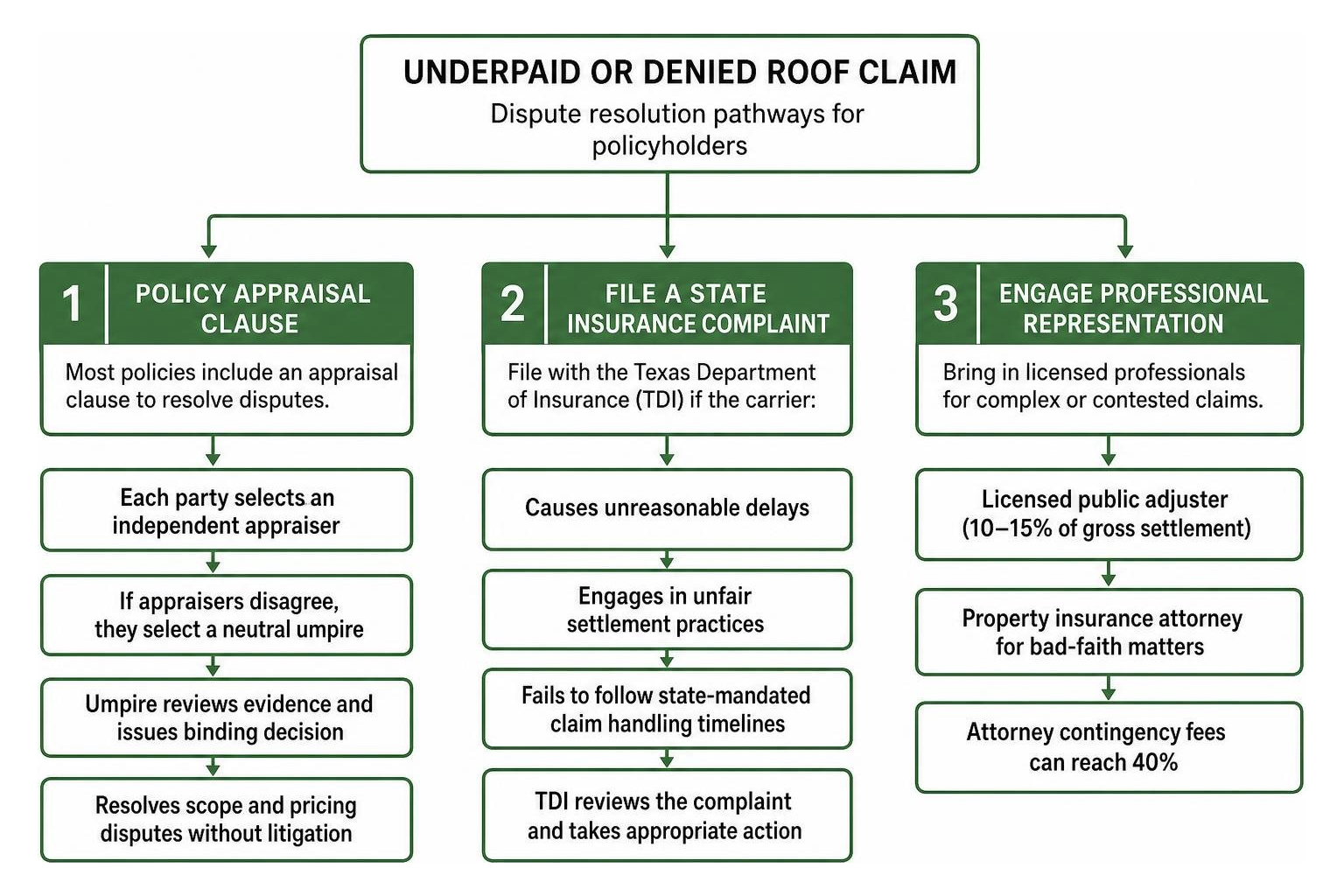
If negotiations stall, policyholders have several avenues:
- Invoke the Policy Appraisal Clause: Most standard policies contain an appraisal clause. Both you and the insurer select an independent appraiser to evaluate the loss. If they disagree, an agreed-upon neutral umpire reviews the evidence and issues a binding determination. This process resolves scope and pricing disputes without courtroom litigation.
- File a State Insurance Complaint: Homeowners can file an official complaint with the Texas Department of Insurance (TDI) if a carrier engages in unreasonable delays, unfair settlement practices, or fails to adhere to state-mandated claim handling timelines.
- Engage Professional Representation: If a loss is complex, policyholders can hire a licensed public adjuster. Texas Insurance Code § 4102.104 limits a public insurance adjuster’s total commission to no more than 10% of the insurance settlement on the claim, so homeowners should review the written fee agreement carefully. When bad-faith practices occur, property insurance attorneys may handle legal action, though contingency fees can be higher.
Texas Deductible Laws and Safe Contractor Practices
Texas law strictly regulates property insurance claims to protect homeowners from fraud. Under Texas House Bill 2102 and Texas Business and Commerce Code § 27.02, it is a criminal violation for any contractor to waive, rebate, absorb, or offset an insurance deductible. Insurance carriers are legally empowered under Texas Insurance Code Chapter 707 to demand proof of deductible payment—such as a cleared bank check, credit card receipt, or financing agreement—before releasing final recoverable depreciation funds.
Be cautious of dishonest contractors promising “free roofs” or asking you to sign an Assignment of Benefits (AOB) contract. An AOB signs away your claim rights, giving the contractor total control over the claim and checks while removing your ability to communicate directly with your carrier.
Additionally, under Texas Insurance Code § 4102.163, a roofing contractor cannot legally act as a public insurance adjuster on a claim where they are also performing the repair work. Ethical contractors provide comprehensive physical damage assessments, photographic evidence, and itemized material estimates, but leave policy interpretation and legal negotiations to the policyholder or licensed adjusters. For policyholders managing unexpected out-of-pocket deductibles, structured roof replacement financing provides manageable payment terms without breaking state compliance laws.
Expert Storm Restoration in Missouri City, Texas
When storms hit your roof, partnering with a dependable local specialist makes all the difference. Reliable Roofing & Restoration provides trusted storm restoration and roofing services across Missouri City, Houston, Sugar Land, Katy, Richmond, Texas, Rosenberg, Cypress, Spring, Tomball, and Fulshear.
Our stellar reputation is built on authentic Google Reviews and reliable craftsmanship across Southeast Texas. We provide free 30–60 minute comprehensive roof inspections complete with clear photo imagery and an actionable repair plan. Whether your home requires an efficient 1 to 2 day complete roof replacement or a routine three-year roof tune-up to reseal sun-exposed pipe flashings, our team delivers the highest standard of protection for your home.
If your property has experienced severe weather or you need professional guidance navigating the insurance restoration process, contact our local team today for expert Missouri City roofing services and schedule your inspection.